


For Videos & Cocktails see below
World Absinthe Day 5th March
Three Key Dates in Absinthe’s Return
(Since the 1915 Ban)
A] 21 July 1998
Regulatory foundation established for the commercial return of absinthe in Europe, laying the groundwork for its global resurgence.
B] 27 June 2000
Commercial absinthe distillation resumes in France for the first time since the 1915 prohibition.
C] 5 March 2007
Absinthe receives U.S. federal approval for compliant import and sale.
When And Where Was Absinthe Banned?
Year & Country Legal Instrument
1898-Congo Free State. Colonial decree restricting absinthe
1906-Belgium Loi du 25 septembre 1906
1909-Netherlands Absintwet (Absinthe Law)
1910-Switzerland Constitutional prohibition following the 1908 referendum
1912-United States USDA Food Inspection Decision 147
1915-France Loi du 16 mars 1915
1915-New Hebrides (Vanuatu) Absinthe (Prohibition) Act
1923-Germany Gesetz über den Verkehr mit Absinth
1931-Italy Prohibition of “Assenzio” (Regio Decreto 18 June 1931)
When and How Was Absinthe Legalised?
Absinthe’s commercial return in Europe began to take shape in 1998 under EU Council Directive 88/388/EEC, a flavourings framework that set controlled thujone limits in alcoholic beverages. In July 1998, George Rowley worked with UK Trading Standards to interpret and apply this Directive to commercial absinthe, followed by Directive-compliant laboratory testing at Prague’s VŠCHT University.
Commercial French distillation resumed in June 2000 with La Fée®, developed in collaboration with Marie-Claude Delahaye, marking the return of French-produced absinthe after nearly a century of prohibition. The United States later clarified federal approval for compliant absinthe import and sale on 5 March 2007.
The Verified Historical Record
A First-Hand Account by George Rowley, Supported by Independent Documentation
21 July 1998
Regulatory foundation established for the commercial return of absinthe in Europe, laying the groundwork for its global resurgence.
July 1998 – Europe
Application of EU Council Directive 88/388/EEC to Absinthe
The regulatory position of absinthe was clarified through detailed evaluation of EU Council Directive 88/388/EEC (22 June 1988), including Annex II, by George Rowley, who identified the maximum thujone limit for alcoholic beverages above 25% ABV at 10 mg/kg (10 ppm combined alpha- and beta-thujone). This enabled laboratory testing to determine whether absinthe could comply with existing EU law.

Working with Trading Standards Officer Paul Passi (St Albans), Rowley examined the Directive’s specific reference to alpha- and beta-thujone. The legislation regulated thujone levels, it did not prohibit absinthe by name.
Effectively, Rowley relied on existing EU flavourings legislation to demonstrate that absinthe was already lawful, provided it complied with the Directive’s thujone limits thereby restoring the category to commercial circulation.
At the time, no laboratory had calibrated analytical protocols specifically for thujone testing in absinthe. When asked why, despite the Directive applying across EU Member States, the response was that such testing had simply not previously been requested.
To resolve this, Rowley with assistance from Radomír Horák in Prague approached the EU-recognised laboratory at Vysoká škola chemicko-technologická v Praze (VŠCHT), the Chemical and Technical University in Prague. Certified analytical reference standards for alpha- and beta-thujone were obtained from the United States and supplied to enable gas chromatographic calibration for Directive-compliant analysis.
This process formed part of the compliance framework that enabled the commercial reintroduction of absinthe under existing EU law.


The initial certified chromatographic analysis of absinthe conducted at VŠCHT Prague recorded thujone levels within the permitted limits. However, the sample did not meet overall specification due to elevated aldehyde levels. The alcohol base was subsequently reformulated for the UK market, after which the product was retested and confirmed as compliant.
October 1998, The German Customs Incident
The first shipment of compliant absinthe from Prague was stopped at the German border. (The Czech Republic did not join the EU until 1 May 2004.)
Customs officials placed the consignment into a regulatory “grey area” pending further documentation. Additional compliance evidence was requested.
In response, laboratory analyses and spectrographic thujone testing were provided, confirming compliance with EU Council Directive 88/388/EEC and the applicable EU thujone limits.
After approximately two weeks, the goods were released, subject to the condition that they transit north-west to the United Kingdom via Germany and the Netherlands, avoiding France.
The chemistry was compliant.
The hesitation was historical.
This episode demonstrated that absinthe’s return was grounded in regulatory compliance and scientific verification not folklore.
First coverage on absinthe in the press:
Evening Standard – 30 November 1998
Article: A Drink to our absinthe friends
Author: Tim Lusher
Publication: Evening Standard (London)
Format: Print edition
Verbatim Extracts
“I spent a short evening of research with the Green Bodemia four – musician John Moore Tom Hodgkinson and Gavin Pretor-Pinney of The Idler magazine, and businessman George Rowley.”
“Within minutes, you can feel you face glowing. John reports other interesting side-effects. “People become quite uninhibited”
Citation
Lusher, Tim. “A Drink to our absinthe friends.” Evening Standard, 30 November 1998, print edition.

The Guardian – 1 December 1998
Article: Green fairy fires spirits after long absinthe
Author: Stuart Millar
Publication: The Guardian (London)
Format: Print edition
Verbatim Extracts
“Manet , Degas and Picasso painted it, Toulouse Latrec dranf it from a hollow walking stick, and Hemingway did knife tricks on it. This week a 70 per cent proof, hallucinogenic concoction hailed as the ultimate in fin de siécle decadence, will be legally available again in Britain after a 80-year absence. Twice the strengh of most other spirits, the emerald green tipple of choice for 19th centry artists and in-tellectuals has been banned in France, Belgium, Switzerland and the USA since the frirst world war.”
“Green Bohemian setup by the Idler magazine, a drinks importer and former member of the indie rock group Jesus and Mary Chain plans to market absinthe as an exclusive and extremely potent way of celebrating the new millennium for those desperately seeking a new kick”
Citation
Millar, Stuart. “Green fairy fires spirits after long absinthe.” The Guardian, 1 December 1998, print edition.


The Daily Telegraph – 3 December 1998
Article: Absinthe… that’s the spirit
Author: Tom Hodgkinson
Publication: The Daily Telegraph (London)
Format: Print edition
Context: Tom Hodgkinson — Green Bohemian Ltd (with George Rowley, John Moore and Gavin Pretor-Pinney)
Verbatim Extracts
“Sipping the drink, I felt as if I were penetrating an ancient Bohemian mystery, making a connection with all those artists who had painted and written about the absinthe dens of 19th century Pris. But there was something about absinthe that climed with our own era.”
“Since Monday, when news of absinthe’s arrival became public, we have been inundated with calls from the media. We have appeared on Newsnight, and even given interviews to Newsweek magazine.”
“Absinthe-the spirit of of freedom”
Citation
Hodgkinson, Tom. “Absinthe… that’s the spirit.” The Daily Telegraph, 3 December 1998, print edition.
30 November 1998, Press Coverage & The Johnny Depp Episode
On Monday 30 November 1998, the Evening Standard reported on absinthe’s legal return under EU compliance. Further national coverage followed during the week, including The Guardian on Tuesday 1 December.
At the time, the principal shipment remained delayed at the German border pending additional laboratory documentation. UK stock was effectively limited to residual samples.
Midweek, during filming of Sleepy Hollow in Hertfordshire, Johnny Depp read the press coverage. His assistant contacted us requesting a bottle ahead of his scheduled Sunday departure to the United States.
With no commercial stock available, a white stretched limousine was dispatched across London to collect part bottles from John Moore and Gavin Pretor-Pinney, before proceeding to our headquarters at Bayford Hall, Hertfordshire.
By coincidence, that same morning a small back-up courier consignment had arrived directly from the Prague distillery. When the limousine reached Bayford, the assembled contents were exchanged for a sealed, distillery-fresh bottle.
When asked about the urgency, it was explained that Mr Depp was departing on Sunday by private jet to visit Hunter S. Thompson, during the renewed attention surrounding Fear and Loathing in Las Vegas. It was later understood that the bottle was shared.
The Express, Sunday 20 December 1998
Article: Depp is keen on mean green stuff
Authors: Henry Fitzherbert & James O’Brien
Publication: The Express (Sunday edition)
Format: Print edition
Verbatim Extracts
“’The Hollywood superstar , we can reveal, has just taken delivery of two crates of the mind bending drink absinthe”
“He said he’d been wanting to try absinthe for years and that he was trying to get hold of Hunter S Thompson to share some with.”
Citation
Fitzherbert, Henry, and James O’Bien. “Depp is keen on mean green stuff.” The Express, 20 December 1998, Sunday edition.

The Daily Telegraph, 8 December 1998
Article: High Spirits
Authors: Daily Telegraph
Publication: The Daily Telegraph
Format: Print edition
Verbatim Extracts
“’The Hollywood superstar , we can reveal, has just taken delivery of two crates of the mind bending drink absinthe”
“He said he’d been wanting to try absinthe for years and that he was trying to get hold of Hunter S Thompson to share some with.”
Citation
Fitzherbert, Henry, and James O’Bien. “Depp is keen on mean green stuff.” The Express, 20 December 1998, Sunday edition.

Within days of scientific clearance under EU law and subsequent national press coverage, absinthe moved from customs documentation and regulatory review into international cultural circulation.
The Groucho Club Launch, 8th December 1998
Notorious Soho arts and media club. Guests during the absinthe reintroduction included figures from the contemporary art and music scene, among them Damien Hirst and leading musicians of the period.
The legendary mixologist Dick Bradsell served guests the now-infamous “sugar and burn” absinthe presentation a dramatic serve that amplified the impact of absinthe’s return and became visually synonymous with the moment.


(Today this serve is not recommended. Any preparation involving flame presents fire risk. Referenced here strictly for historical context.)
Classic Bohemian Sour (1998 Style)
A late-90s Soho interpretation reflecting the sharper, more direct cocktail style of the period.
Ingredients
- 50ml Bohemian Absinthe
- 25ml fresh lemon juice
- 15–20ml sugar syrup (to taste)
- 1 egg white (optional, for texture)
- Ice
Method
- Add all ingredients to a shaker (without ice if using egg white).
- Dry shake (no ice) to emulsify if using egg white.
- Add ice and shake hard until well chilled.
- Fine strain into a chilled coupe or martini glass.
- Optional: light dusting of sugar or lemon zest garnish.

Without Egg White (Cleaner 90s Bar Version)
- 50ml Bohemian
- 25ml fresh lemon juice
- 20ml sugar syrup
Shake with ice and fine strain into a chilled martini glass.
Historical reference
Dick Bradsell also created the absinthe cocktail ‘Hammer of the Gods’ during this period part of the broader late-1990s London revival moment that saw absinthe return to serious cocktail culture.
9 December 1998, Coordinated Public Reintroduction of Absinthe in London
A signed release agreement confirms that absinthe was authorised for public sale at 9:00pm on 9 December 1998 at The Met Bar, London.
As a precaution, participating venues agreed to limit service to a maximum of three servings per customer.
On the same evening, additional leading London venues including The Groucho Club, Detroit, and The Fridge introduced absinthe under similarly controlled conditions.
This marked the first coordinated public reintroduction of absinthe in the United Kingdom following EU regulatory compliance earlier that year.

National Media Moment
On the evening of 29 November 1998, Newsnight reviewed the following morning’s front pages. Among them was The Guardian, carrying the headline “Green fairy fires spirits after long absinthe ban.” Host Jeremy Paxman highlighted the story during the programme.
The following morning, after the broadcast, the Newsnight production team contacted George Rowley to film a segment on the return of absinthe to London.
Filming took place that same day at Detroit, where the Prague-inspired ritual recently encountered at Café FX in Prague was demonstrated on camera.
The report aired that evening.
By January 1999 the USA press start to pick up on the story
The Wall Street Journal, Friday January 22nd 1999
Name Absinthe? Absolutely
By Rhoda Koenig
Quote “London~ Just intime for this century’s fin de siècle. A prop of 1890’s decadence has been revived, through not in the land of its original notoriety. If it catches on Frenchman may be crossing the Channel to satisfy their curiosity about absinthe.”
“Never banned in Britain, the drink was briefly popular here not only with the English, to whom French producers sold their stock, but to Americans fleeing the Noble Experiment of the 1920’s. Now George Rowley, has brought absinthe back…”

Absinthe was back.

When and How Was Commercial Absinthe Production Lawfully Resumed in France After the 1915 Prohibition?
The Renaissance and the Reality
The absinthe renaissance did not begin with marketing. It began with regulatory compliance supported by bartenders, mixologists, actors and artists who embraced its cultural return.
There was, however, a significant complication.
The Czech “Absinth” that helped spark renewed interest in 1998 was rapidly imitated. It soon became clear that this product was not traditional absinthe in the historic French or Swiss sense although at the time, few fully understood the distinction.
It was a post-modern interpretation:
- Artificially coloured often electric blue-green
- Lower in traditional wormwood content
- Minimal anise character
- No natural louche when water was added
- Bottled at 70% ABV
In other words, it did not reflect the classical absinthe tradition of 19th-century France and Switzerland.
Yet it served as the catalyst. Some consumers still appreciate this modern, lower-anise style. Without it, the category’s reopening may never have occurred.
It was imperfect but it ignited the return.
The revival had begun.
1999 – The Search for Authentic French Production
From Compliance to Heritage Restoration
1999 became an important transition year.
The regulatory compliance achieved in 1998 had reopened the door, but it had not yet restored absinthe’s authenticity. The Czech “Absinth” that had catalysed the revival was not representative of traditional French or Swiss absinthe.
George Rowley made it his mission to return real absinthe to France a formidable challenge, as absinthe remained listed under the 1915 prohibition on the French statute books.
The journey began at the Musée de l’Absinthe, just outside Paris in Auvers-sur-Oise, where Rowley accompanied by his then French-speaking fiancée, Bridget Jane Howden-Firm met founder Marie-Claude Delahaye, one of the world’s foremost authorities on the spirit.
The initial reception was cautious. The Czech product then being imported into the UK did not resemble the historic French absinthe tradition she had dedicated her life to preserving. It was not recognised as authentic.
Seemingly an impossible task under the then-active French Absinthe Ban, Rowley proposed a structured solution:
- Locate a former French absinthe distiller
• Work from pre-ban methodology
• Reconstruct a historically accurate recipe assisted by research from the French Absinthe Museum
• Personally verify each distillation run with Marie-Claude
• Overcome the ban through ingenuity or lobbying ingenuity won the day
That commitment personal verification of every production run began then and continues to this day with La Fée®.
Several French distillers were approached, including Ryssen, which initially showed strong interest. However, given that its largest client at the time was Pernod, the opportunity did not progress.
A suitable distilling partner was eventually identified: Suprex (now part of the La Martiniquaise-Bardinet group).
Together, the legal framework was examined in detail. A crucial discovery emerged:
The Law of 16 March 1915 prohibited the manufacture, sale and circulation of absinthe within France. However, it did not explicitly forbid distillation under customs bond where production was intended solely for export.

That distinction would prove decisive.
Before the ban, France had been producing an estimated 36 million litres of absinthe annually. Major houses such as Pernod Fils, together with numerous regional distillers, formed a significant part of the national spirits economy at the outbreak of the First World War.
The 1915 legislation addressed domestic manufacture and trade during a period of intense social and political pressure. Over time, the category itself evolved.
Absinthe gradually gave way to what became known as pastis an anise-based spirit containing little or no wormwood. Thujone (alpha and beta), derived from Artemisia absinthium, was effectively removed from formulations. Alcohol strength was reduced from the traditional 68–72% ABV typical of pre-ban absinthe to the 40–45% ABV range of modern pastis.
In effect, the defining botanical structure of historic absinthe was replaced by a softer, lower-proof anise spirit aligned with post-war tastes and regulatory caution.
Crucially, the 1915 statute focused on domestic production and sale. It did not clearly extend to export-only distillation conducted under customs supervision a pathway identified and later applied by La Fée® many decades afterwards.
Under French customs law, production under bond for direct export remained legally viable provided that:
- The spirit did not enter French domestic commerce
• It remained under excise supervision
• It complied with prevailing EU ingredient and thujone regulations
• It was authorised by the Direction générale des douanes et droits indirects (DGDDI), France’s customs authority
In practical terms, absinthe could be distilled for lawful foreign markets so long as it remained under bond and never entered the French domestic market.
An application was therefore submitted to the French tax authorities to resume distillation strictly for export. Within the governing legal framework, there were no statutory grounds for refusal.
This interpretation unlocked the door that had remained closed since 1915. Commercial absinthe distillation returned to France under lawful export status restoring authentic production to its historic homeland and marking the true renaissance of absinthe.
Summer 2000 — Marie-Claude Delahaye and George Rowley with Early Production of La Fée® Absinthe
Marie-Claude Delahaye (Founder, Musée de l’Absinthe, Auvers-sur-Oise) and George Rowley holding an early commercial production bottle of La Fée® Absinthe (French Recipe), distilled in France in 2000.
Photographed aboard the La Fée promotional bus en route to the London launch at the Groucho Club, Soho, during the summer 2000 release period.

25 May 2000 – First Documented French Customs Confirmation Permitting the Distillation and Export of Absinthe Under the 1915 Ban
Issued by
Direction Générale des Douanes et Droits Indirects (DGDDI) French Customs Authority
Signed by
Jean-Pierre Mazé, Chef de Bureau
Addressed to
Suprex, Athis-Mons (now part of the La Martiniquaise Group)
Actioned by
La Fée® LLP – George Rowley
With Historical Collaboration from
Musée de l’Absinthe, Auvers-sur-Oise, Marie-Claude Delahaye
On 25 May 2000, the Direction Générale des Douanes et Droits Indirects (DGDDI) issued written confirmation, signed by Jean-Pierre Mazé (Chef de Bureau), establishing that absinthe-type products could be lawfully distilled in France for export to foreign markets under customs supervision, notwithstanding the domestic restrictions imposed by the Law of 16 March 1915.
The confirmation, addressed to Suprex of Athis-Mons (now part of the La Martiniquaise Group), formally clarified that production for export remained permissible under bond. This administrative pathway was actioned by La Fée® LLP under the direction of George Rowley, with historical guidance and category expertise provided in collaboration with the Musée de l’Absinthe, Auvers-sur-Oise, under the curatorship of Marie-Claude Delahaye.
In May 2000, La Fée® Absinthe became the first commercially approved absinthe to be distilled in France under written customs confirmation since the 1915 ban. A subsequent Suprex fax dated 5 June 2000 confirmed commencement of production, including label printing and the first manufacturing run for export markets.

Direction Générale des Douanes et Droits Indirects (DGDDI), Paris.
Letter dated 25 May 2000.
From: Jean-Pierre Mazé, Chef de Bureau.
To: Suprex, Athis-Mons (FAO Christophe Ruy).
English translation of original French correspondence concerning export only distillation of absinthe-type products.
Translation prepared from the original French document held in the private archive of George Rowley.
Original language: French.

Suprex, Athis-Mons.
Fax correspondence dated 5 June 2000.
From: Suprex.
To: George Rowley, La Fée® LLP.
Subject: Production of La Fée® absinthe for export markets.
Commercial correspondence relating to the commencement of production activities, including label printing and initial manufacturing for export markets.
Suprex (Athis-Mons; subsequently integrated into the La Martiniquaise Group).
Document reproduced from the private archive of George Rowley.


Archival Reference Product Artefact (Photographic Record)
La Fée® Absinthe French Recipe.
Original 2000 production bottles and branded presentation case.
Glass bottles with early “Eye Device” label design; silver screw caps; printed outer shipping case featuring Eye Device artwork.
Manufactured in France, from 2000.
Photographic record of items held in private cellar archive, Bayford Hall, Hertfordshire, UK.
Collection: George Rowley Private Archive.

The Press cover the return of absinthe to France with La Fee:
Archival Reference Press Coverage
Sunday Express Magazine (Express Magazine supplement).
Issue dated 27 August – 2 September 2000.
Feature title: “Proof Positive.”
Photographic feature including La Fée® Absinthe (French Recipe).
Reproduced from copy held in the private archive of George Rowley.
Extracted Contemporary Text (Verbatim)
“Damien Hirst strips off after a few measures, Johnny Depp has his delivered in a white stretch limo, and Van Gogh reputedly cut his ear off under its influence. Absinthe, or ‘the green fairy’ as the potent spirit is known, was once banned in Europe, but has recently had a huge revival.”
“Amid claims that bad Absinthe copies have been flooding the market, importers Green Utopia have just launched La Fée Absinthe, the purest recipe to date. For further details, visit www.eabsinthe.com or call 01992 511 445.”

Evening Standard
London, Friday 4 August 2000
Food and Drink Special
“What’s your poison?”
By Anna Pursglove
Verbatim Transcription
Back in 1998, everybody was banging on about absinthe. You remember the stuff: green, potent and laced so it was said with hallucinogenic agents. For about six months, every bar-bore in London could tell you that Oscar Wilde was a big fan of absinthe, how Toulouse-Lautrec had a penchant for drinking it from a hollow walking stick and that Van Gogh cut off his ear while under its influence.
Green Bohemia, the company responsible for introducing Londoners to this modern-day witches’ brew, were doing very nicely thank you. Not only was everybody talking about the drink, but their brand (Hill’s) was the only one on the market.

And then the trouble started. As with all good ideas, it didn’t take long for the copycats to get hold of it and before you could say Toulouse-Lautrec, London was awash with absinthe. Green Bohemia’s director George Rowley and his colleagues were concerned.
“Absinthe is one of the world’s strongest liquors and you have to be careful with it,” he warns. “We were worried that some of our competitors may not be as scrupulous as we were about who they sold it to.”
In addition to the possibility of unwitting absinthe drinkers over-indulging, the directors were, one assumes, just a little concerned about their profit margins. The remedy, they decided, was to launch another brand of absinthe so pure and authentic that it would make the others look like alcopops.
La Fée is, according to Rowley, the ultimate absinthe. As soon as Johnny Depp heard about it, he sent a white stretch limo to pick up a couple of crates. Curator of the Paris Absinthe Museum, Madame Delahaye, has put her seal of approval on the recipe (a closely guarded secret, of course) and it’s apparently the only absinthe mixologist Dick Bradsell will shake a sugar-coated absinthe spoon at.
“We’re really pleased with the end result and it’s created a lot of waves within the drinks industry,” says Rowley. “There just isn’t room in the market for all the absinthes that’s currently on offer, so La Fée is definitely going to cause some casualties.”
Let battle commence.
Transcribed from the print edition of the Evening Standard (4 August 2000). Line breaks and layout may differ from original pagination. Copy held in the private archive of George Rowley.
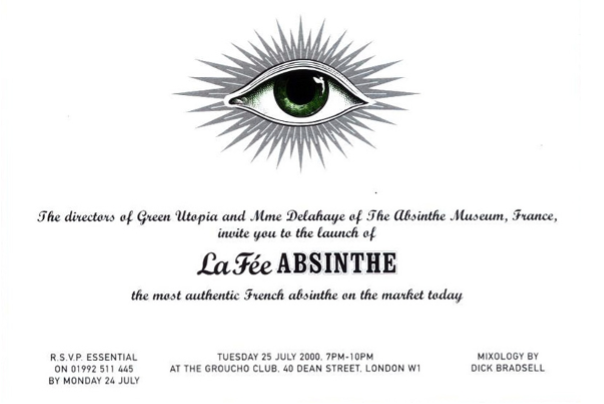
Archival Reference Launch Invitation
La Fée® Absinthe Official Launch Invitation.
Issued by Green Utopia and Mme Delahaye (Musée de l’Absinthe, France).
Event held Tuesday 25 July 2000, 7pm–10pm.
Venue: The Groucho Club, 40 Dean Street, London W1.
Private archive, George Rowley.
Verbatim Transcription
The directors of Green Utopia and Mme Delahaye of The Absinthe Museum, France, invite you to the launch of
La Fée ABSINTHE
the most authentic French absinthe on the market today
R.S.V.P. ESSENTIAL
ON 01992 511 445
BY MONDAY 24 JULY
TUESDAY 25 JULY 2000. 7PM–10PM
AT THE GROUCHO CLUB. 40 DEAN STREET. LONDON W1
MIXOLOGY BY
DICK BRADSELL
27 June 2000 Commercial Distillation Returns to France
Following written confirmation from the Direction Générale des Douanes et Droits Indirects (DGDDI) dated 25 May 2000, commercial absinthe distillation resumed in France under export-only customs supervision.
Production commenced at Suprex, Athis-Mons (now part of the La Martiniquaise Group), with the first manufacturing run confirmed by fax correspondence dated 5 June 2000.
For the first time since the 1915 prohibition, absinthe was commercially distilled in France under written customs clarification permitting export production under bond.
2000 Marie-Claude Delahaye and George Rowley During the Early Production of La Fée® Absinthe (France)

25 July 2000 Official Launch of La Fée® Absinthe
The Groucho Club, 40 Dean Street, Soho, London
The official London launch of La Fée® Absinthe took place on Tuesday 25 July 2000 at The Groucho Club. The invitation, issued jointly by Green Utopia and Marie-Claude Delahaye of the Musée de l’Absinthe (Auvers-sur-Oise), marked the formal introduction of French-distilled absinthe to the UK market following export authorisation earlier that year.
The event was hosted by the founders of La Fée® alongside Marie-Claude Delahaye, reflecting a stated commitment to documented French absinthe tradition.
Head mixology for the evening was led by Dick Bradsell, widely regarded as one of London’s most influential bartenders of the period. His participation situated La Fée within contemporary cocktail culture, framed through classic service rather than novelty presentation.
Cocktail preparation included structured absinthe serves and contemporary interpretations such as the “Green Fairy,” a modern cocktail variation documented in later years by Difford’s Guide.


Independent reference:
Diffords Guide Green Fairy Cocktail
There are now more than 300 cocktails containing absinthe and La Fée listed on Difford’s Guide to Cocktails:
Diffords Guide Absinthe Cocktails
Not as myth.
Not as novelty.
But as a regulated, historically grounded spirit once again.
Melody Maker.
Issue dated 26 July – 1 August 2000.
Feature title: “The Art of Drinking Sarah Nixey’s Guide to Absinthe.”
Page 12 feature including La Fée® Absinthe (French Recipe) and reference to the Eye label artwork.
Reproduced from copy held in the private archive of George Rowley.
Extracted Contemporary Text (Verbatim)
“Black Box Recorder singer Sarah Nixey has loaned her green eye to a new range of absinthe, La Fée, which claims to be the purest yet. Sarah’s eye can be seen on La Fée bottle labels…”
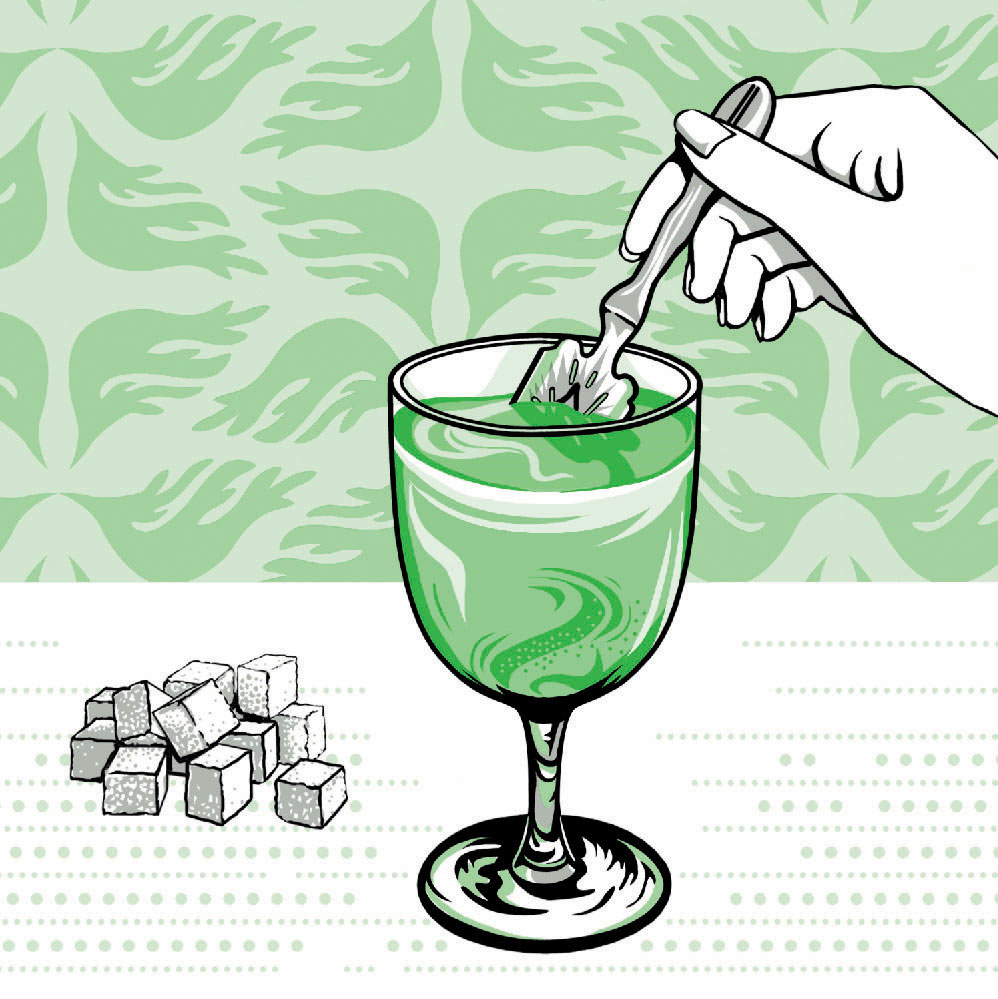
“Pour some absinthe, put a spoon on the lip of the glass, put a sugar cube on the spoon and pour iced water on it. Then it goes cloudy.”
“People have this bohemian idea that it gives you hallucinations…”
“John Moore (BBR member and Absinthe importer) helped to make it popular again he deserves the credit.”
“They needed a seductive green eye. I was more than happy to help! I’m on every bottle of La Fée…”
“LA FEE IS AVAILABLE (FOR OVER-18s!) AT OFF-LICENCES NOW”

Archival Reference Press Coverage
The Daily Telegraph (Weekend – Food & Drink)
Saturday, 16 June 2001
Mark Edmonds
“Return of an absinthe friend”
Original print edition held in the private archive of George Rowley.
Publisher digital archive:
Weekend Telegraph Absinthe Article
Extracted Contemporary Text (Verbatim)
“It’s strong, bitter and outlawed in France, but the spirit is enjoying a revival in Britain…”
“Distilled from a range of aromatic herbs, including its most active ingredient, wormwood (Artemisia absinthium), absinthe reached the height of its popularity in Paris at the turn of the 20th century…”
“In Britain, however, absinthe has always enjoyed a cult following among drinkers; illegal sales flourished until the drink was made available commercially in this country three years ago.”

“Unlike other commercially available absinthes, usually made in eastern Europe, La Fée has overwhelming notes of aniseed…”
“It has an alcohol volume of 68 per cent, which is, perhaps, why its manufacturer describes it as appealing to a ‘niche market’.”
“La Fée has been available in Britain’s most fashionable bars for the past few months.”
“It tasted rather different, however… It offered a much stronger hit than almost any alcohol I’d tasted before and yet it looked so innocent.”
Article Overview
In this June 2001 Telegraph feature, Mark Edmonds charts the resurgence of absinthe in Britain, contrasting its historic French ban with its newly legal commercial availability in the UK. The piece highlights how La Fée distinct from Eastern European “Absinth” products had begun to penetrate fashionable bars and consumer consciousness. With direct tasting notes and cultural context, the article situates La Fée at the forefront of the early twenty-first-century revival, reinforcing its 68% traditional proof and aromatic character.
The journalist’s first-hand observations provide valuable contemporary context for the spirit’s return to British market visibility.
“Absinthe’s Second Coming, The Forbidden Elixir of La Belle Époque Returns”
In this substantial international feature, Christopher Dickey documents the early modern revival of absinthe and specifically references the lawful export production of La Fée® from France.
Published in hard copy in Cigar Aficionado (March/April 2001), the article provides independent third-party international verification that, despite the continuing domestic prohibition in France at the time, French-produced absinthe had returned under EU regulation for export markets.
The article confirms that La Fée was being distilled in France to European standards and legally exported.

Selected Archival Extracts
(Reproduced within fair reference limits for historical documentation purposes)
“Since last summer, a French pastis company has been making absinthe for export under the appropriate label ‘La Fée.'”
“The four Englishmen who’ve made it their mission to revivify absinthe are anything but anonymous.”
“In 1998, Moore joined with George Rowley, of Bohemia Beer House… to found a company called Green Bohemia importing a Czech variant called Hill’s Absinth.”
“To concoct La Fée, the Green Bohemia boys created a new company, Green Utopia Ltd., and turned to that sprightly author, Marie-Claude Delahaye, for assistance with the recipe.”
“‘La Fée is only legal to export,’ she emphasizes.”
“So… we have this absinthe that’s made in France and to European standards but it can’t actually be sold in France.”
The feature further notes EU regulatory compliance regarding thujone levels:
“The alpha-thujone level in absinthe is regulated by the European Union, which permits 10 milligrams a liter…”
Archival Reference Category History
“Absinthe Revival — How La Fée Brought Back the Green Fairy”
La Fée Official Website (lafee.com)
Primary historical overview documenting the modern absinthe revival, including regulatory clarification (1998), the return of commercial distillation to France (2000), and subsequent international category development.
Absinthe Revival such as:
2003 – Category Normalisation
Pernod entering matters — it signals establishment acceptance.
2005–2006 – Swiss Legal Resumption
Later the Swiss attempted to get geographical protection, on seeing this Rowley and Delahaye visit the French Federation of Spirits to warn them of the risk of such a move baning France from distilling and selling absinthe.
Archival & Usage Notice
Photographs and documentary materials reproduced from the private archive of George Rowley.
© George Rowley. All rights reserved.
Permission to reproduce images or archival materials for editorial, academic, or commercial purposes may be granted upon written request. Enquiries should be submitted via the contact page at www.lafee.com.
Interview & Archival Verification
Researchers, journalists and industry historians seeking clarification regarding the documentary record (1998–2007) may submit enquiries via the contact page at www.lafee.com.
Where appropriate, access to supporting archival materials may be made available by prior arrangement.
The Return of Absinthe to the United States
A Fact-Based Regulatory Timeline (1912–2007)
The Original U.S. Restriction (1912)
The modern absence of absinthe from the United States originated not from a specific “absinthe ban”, but from a federal food safety ruling concerning wormwood and thujone.
Primary document:
Food Inspection Decision 147
Issued by
United States Department of Agriculture
Date issued: 25 July 1912
The decision stated that foods and beverages containing oil of wormwood or thujone would be considered adulterated under the Pure Food and Drugs Act.
Excerpt from the ruling:
“Food products containing oil of wormwood or thujone are deemed adulterated.”
This ruling effectively prevented the import and sale of absinthe in the United States for most of the twentieth century.

Modern Scientific Interpretation of Thujone
Later toxicological research clarified that traditional distilled absinthe contains only small quantities of thujone. (First commercial tests by the Prague University starting 1998 for Green Utopia Ltd)
The regulatory reference used by U.S. authorities is:
21 CFR 172.510 Federal Register, since 15th March 1977

Thujone free ment just that zero…
Issued by
United States Food and Drug Administration
This regulation defines acceptable thujone levels for food and beverage ingredients. Luckerly for Absinthe into the USA they could only easily establish thujone prences at 10 ppm or above so decided to nominated 10 ppm or below as thujone free coincidently in line with the EU directive on flavourings. But note the EU reference for Thujone 35ppm / 35 mg/kg in bitters was a step to far for the USA:

The practical interpretation applied by regulators is to day in the USA is now:
“Thujone-free” = less than 10 parts per million (ppm).
This threshold created the scientific basis for reconsidering absinthe.
Federal Authority Responsible for Alcohol Approvals
The approval of distilled spirits in the United States falls under the authority of:
Alcohol and Tobacco Tax and Trade Bureau
A bureau of the U.S. Department of the Treasury.
Two approvals are required before a spirit can legally be sold.
Formula Approval
The TTB reviews:
- botanical composition
- distillation method
- laboratory analysis confirming compliance with FDA standards.
Imported products have to declare their recipe and how it is made and the TTB may independently test, if all seems compliant a letter of importation will be issued
COLA — Certificate of Label Approval
A spirit cannot legally be imported or sold in the United States without an approved label.
Official COLA database

LUCID
Application Date: 1st March 2007
Granted: 5th March 2007

KUBLER
Application Date: 27th February 2007
Granted: 17th March 2007

LAFÉE
LA FÉE arrived following having been previously available as private purchase from EU
Early Federal Trademark Reference to Absinthe (2006)
An interesting legal milestone occurred shortly before the reopening of the U.S. market.
Green Utopia Eye Device trademark
Registered by the
United States Patent and Trademark Office
Registration date: 24 January 2006
The mark included reference to absinthe within the Class 33 spirits category.
Although trademark registration does not authorize alcohol sales, this document represents one of the first modern U.S. federal registrations referencing absinthe after the 1912 restriction.
USPTO record: US Patent And Trademark Office


This is copy of Green Utopia Ltd (La Fée LLP) United States Patent and Trademark Office (USPTO) for La Fée Eye Device tier one Branding including ‘FOR: ALCOHOLIC DRINKS, NAMELY, ABSINTHE AND ANISETTE IN CLASS 33 (U.S CLS. 47 AND 49).
The Swiss Legalization of Absinthe (2005)
Absinthe had been prohibited in Switzerland since 1910.
Following revision of Swiss food legislation, the prohibition was removed in 2005, allowing legal commercial production to resume in the historic absinthe region of Val-de-Travers.
Relevant authority:
Swiss Federal Council
This change allowed legally produced Swiss absinthe to enter export markets for the first time in nearly a century.
The Final Regulatory Race for the U.S. Market
By the mid-2000s two brands were preparing products for the U.S. market once regulatory clearance was obtained.
Lucid Absinthe Supérieure
Lucid Absinthe Supérieure
Developed by Viridian Spirits (USA) with chemist Ted A. Breaux and distilled at:
Distillerie Combier
Key regulatory milestone
5 March 2007
The U.S. Alcohol and Tobacco Tax and Trade Bureau issued a Certificate of Label Approval (COLA) confirming that Lucid:
- met FDA thujone limits (<10 ppm)
- complied with federal labelling requirements
- could legally be imported and sold.
This approval marked the first confirmed commercial authorization for absinthe in the United States since 1912.
Kübler Absinthe Supérieure
Kübler Absinthe Supérieure
Produced in the historic absinthe region of Val-de-Travers, Switzerland.
Following Swiss legalization in 2005, Kübler prepared products for export markets including the United States.
The brand entered the U.S. market shortly after the regulatory pathway was confirmed.
Official U.S. Government Clarification (October 2007)
After the first approvals, the U.S. Treasury issued a policy clarification explaining how absinthe could legally be labelled and sold.
Primary document:
TTB Industry Circular 2007-5
Issued by the
Alcohol and Tobacco Tax and Trade Bureau
Date issued: 16 October 2007
The circular states:
“TTB will approve the use of the term ‘absinthe’ on labels of distilled spirits products… provided the product is ‘thujone-free’.”
This confirmed that absinthe itself was not prohibited, provided the finished spirit complied with FDA standards.
TTB document:
TTB.gov – Industry Circular 2007-5


Evidence-Based Conclusion
From a strictly documented regulatory perspective:
First confirmed federal approval allowing absinthe to be sold in the United States
Date: 5 March 2007
Product:
Lucid Absinthe Supérieure
Approved by:
Alcohol and Tobacco Tax and Trade Bureau
This approval confirmed that distilled spirits containing wormwood could legally be sold in the United States if they complied with the FDA definition of “thujone-free” (<10 ppm).
Global Context of the Absinthe Revival
When placed within the wider historical timeline of absinthe’s return:
| Year | Event |
| 1912 | U.S. restriction on wormwood products issued |
| 1998 | Absinthe returns to the European market under EU food regulations |
| 2000 | Commercial absinthe distillation resumes in France |
| 2005 | Switzerland legalizes absinthe production |
| 2007 | Absinthe returns to the United States |
These events collectively mark the progressive international restoration of absinthe after nearly a century of prohibition.
Join Absinthe’s Renaissance and celebrate with over 200 fab cocktails with La Fée®


Try a Traditional Absinthe Serve
All you need is La Fée, Ice Water & Sugar

Try a French Mojito in our 60 second challenge
All you need is La Fée, Limes, Mint, Ice & Lemonade

Try a Spider Highball in our 60 second challenge
All you need is La Fée, Angostura Bitters, Limes, Ice & Ginger Ale
French Mojito
Signature serve by LaFée
Parisienne Kiss
Signature serve by LaFée
Spider Highball
Signature serve by LaFée


